
If someone calls you an “NPC” in a text, comment, game, or dating chat, you may wonder if they are joking, insulting you, or talking about gaming.
The answer depends on the context.
The term NPC meaning slang has become common across TikTok, Instagram, Snapchat, gaming communities, and everyday texting.
You may see someone say, “Bro is an NPC,” “Why are you acting like an NPC?” or “That response was so NPC.”
These uses can sound strange if you only know NPC as a gaming term.
In simple terms, NPC comes from non-player character, a character in a video game that is controlled by the game rather than a human player.
Online, however, the word has taken on a wider meaning.
People may use it for someone who seems predictable, repeats common ideas, follows a trend without thinking, or acts as if they are on autopilot.
This guide explains the NPC meaning slang in simple English.
You will learn what it means, how people use it, when it is funny, when it can be rude, and how to reply when someone calls you an NPC.
What Does “NPC meaning slang” Mean in Text?
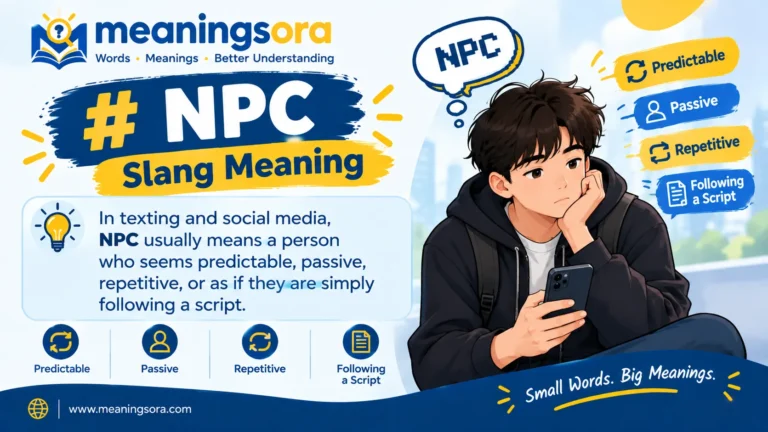
In texting and social media, NPC usually means a person who seems predictable, passive, repetitive, or as if they are simply following a script. It comes from “non-player character,” a video game character controlled by the game. Depending on the context, it can also describe someone who copies trends, gives basic replies, or acts without much personal input.
Common interpretations include:
- A person acting predictable or scripted.
- Someone who seems unaware of what is happening.
- A person who copies popular trends or opinions.
- A joke about someone behaving like a background video game character.
The word is often playful, but it can also be an insult.
The Most Common Meanings of “NPC meaning slang”
1. Someone Who Acts Predictably
This is one of the most common slang uses.
Calling someone an NPC can mean that their behavior seems very easy to predict. They may say the same things, follow the same routine, or react in the same way every time.
For example:
“Every time we talk about movies, he gives the same answer. He’s such an NPC.”
Here, NPC means the person seems to have a fixed script.
It does not always mean the person is boring. It can simply mean their behavior was so predictable that the speaker made a gaming joke about it.
2. Someone Who Seems Like They Are on Autopilot
NPC can also describe someone who looks like they are moving through life without paying much attention.
You might see this use in a video where a person walks through a busy place while staring ahead with a blank expression.
Example:
“I walked into the store before coffee and felt like an NPC.”
In this case, the speaker is usually joking about themselves.
The idea is that they are physically moving and doing things, but their brain does not feel fully switched on.
3. Someone Who Repeats Popular Opinions
Online, NPC can have a stronger meaning.
A person may be called an NPC when they appear to repeat opinions they see online without adding their own thoughts.
Example:
“He just repeats whatever he sees in the comments. NPC behavior.”
This use is more critical. The speaker is suggesting that the person is not thinking independently.
However, calling someone an NPC does not prove that they lack original thoughts. It is usually an opinion or insult, not a factual description.
4. Someone Who Copies Trends
Social media has made trends spread very quickly. A person may wear the same style, use the same phrase, make the same type of video, or follow the same trend as thousands of other people.
Someone might jokingly call this “NPC behavior.”
Example:
“Everyone started saying that phrase this week. NPC mode activated.”
This use is often lighthearted. The speaker may be making fun of how quickly people copy a popular trend.
5. A Background Person in a Social Situation
NPC can also describe someone who seems like a background character.
Imagine a party where one person is quietly standing in the same place, saying very little, and watching everyone else.
A friend might say:
“Why is he standing there like an NPC?”
The comparison comes from video games. NPCs often exist in the background to make a game world feel alive.
This meaning does not necessarily suggest anything serious. It can simply describe someone’s appearance or behavior in a funny way.
6. A Person Who Gives Basic or Repeated Replies
NPC can describe repetitive texting too.
Suppose someone always answers with:
“Okay.”
“Sure.”
“Nice.”
“Cool.”
A friend may jokingly say:
“Bro is texting like an NPC.”
The point is not that the person is literally a video game character. Their replies simply feel limited or automatic.
7. A Literal Gaming Character
The original meaning still matters.
In gaming, an NPC is a non-player character. The game controls this character instead of a human player.
NPCs can give missions, sell items, provide information, guard locations, or simply make the game world feel populated.
For example:
“Talk to the NPC near the village.”
Here, NPC is being used in its normal gaming sense, not as an insult.
This distinction is important because the same word can have a completely different meaning online.
How “NPC meaning slang” Is Used in Real Conversations
Friends & Casual Texting
Among friends, NPC is often used as a joke.
A friend might notice that you always order the same food and say:
“You order the same thing every time. NPC.”
Or someone may be unusually quiet:
“Why are you standing there like an NPC?”
The tone depends on the friendship. Close friends may use the word without meaning anything serious.
If someone says:
“NPC behavior lol”
they may simply be teasing you.
But if they say:
“You’re literally an NPC. You have no original thoughts.”
that is much more insulting.
Look at the full message, not just the word.
Instagram & Snapchat
On Instagram and Snapchat, NPC often appears in comments, captions, stories, and direct messages.
A person may comment “NPC” under a video where someone repeats a trend or performs the same action as many other people.
It can also describe a video that looks strange or highly repetitive.
For example:
“Everyone doing this trend looks like NPCs.”
Another common use is self-mockery:
“Me walking into class after sleeping two hours: NPC mode.”
In this type of post, NPC usually means tired, automatic, or mentally switched off.
The term can also appear in short comments because social media users often prefer quick slang over long explanations.
Dating Apps
NPC can show up in dating conversations, especially when someone thinks a profile looks too generic.
For example:
“Your profile gives NPC energy.”
This might mean the profile feels basic or similar to many others.
Someone may also use NPC to describe boring opening messages:
“Hey.”
“How are you?”
“What do you do?”
If every match sends the same message, a person may joke that the conversation feels like talking to an NPC.
However, using NPC on a dating app can easily come across as rude. When talking to someone you do not know well, sarcasm can be misunderstood.
Gaming & Online Communities
Gaming is where NPC comes from, so this is one of its most natural settings.
Players use NPC to talk about characters controlled by the game.
Example:
“The NPC gave me a new quest.”
Gamers may also use the word as slang for a player who behaves in a predictable way.
For example:
“He just stands there every round. Total NPC.”
Gaming communities may also use “NPC energy,” “NPC behavior,” or “NPC mode.”
The exact meaning can change from one community to another, but the basic idea usually involves predictable or scripted behavior.
Work or Professional Chat
NPC is less suitable in professional communication.
A coworker might understand the joke, but a manager, client, customer, or new colleague may not.
For example, saying:
“The customer is acting like an NPC.”
may sound disrespectful if the message is seen by other people.
In casual workplace chats, friends may use the term as a joke. But in formal messages, reports, emails, and meetings, clearer words are better.
Instead of saying someone is an NPC, you can say:
- “Their response was very repetitive.”
- “They seemed distracted.”
- “The conversation felt scripted.”
- “The message was very generic.”
These phrases are clearer and more professional.
Is “NPC meaning slang” Rude, Flirty, or Offensive?
NPC is usually casual or teasing, but it can be rude depending on how it is used.
The context matters more than the word itself.
When NPC Is Playful
NPC can be harmless between friends.
For example:
“You eat pizza every Friday. NPC routine.”
This sounds like friendly teasing.
A person may also call themselves an NPC:
“I woke up, went to work, came home, and repeated the same day. NPC life.”
Self-use often makes the word feel less aggressive.
When NPC Is Negative
The word becomes more insulting when it suggests that someone cannot think for themselves.
For example:
“You just believe everything you see online. NPC.”
The speaker is attacking the person’s ability to think independently.
This can start an argument, especially during discussions about serious topics.
When NPC Is Flirty
NPC is not normally a romantic or sexual term.
Still, flirting often uses teasing. Someone might say:
“Stop being an NPC and talk to me.”
If the conversation already has a playful tone, this could be light flirting.
The word itself does not mean “flirty.” The surrounding conversation creates that meaning.
When NPC Can Be Offensive
It can become offensive when used to mock someone’s intelligence, personality, appearance, or beliefs.
For example:
“You’re an NPC with no brain.”
That is clearly an insult.
The safest rule is simple: NPC is usually okay as a joke with friends, but risky when used to judge strangers or serious topics.
How to Respond When Someone Says “NPC meaning slang”
Your best response depends on the tone.
Casual Replies
If they are clearly joking, you can keep the conversation light.
“At least my battery is fully charged.”
“NPC? I prefer main character.”
“Only on weekdays.”
“What mission do you need?”
Funny Replies
If you want to play along:
“Quest accepted.”
“Dialogue option unavailable.”
“Please wait. My next line is loading.”
“I have three dialogue options. Choose wisely.”
These replies work especially well in gaming or meme-heavy chats.
Neutral Replies
If you are unsure what they mean:
“What do you mean by NPC?”
Or:
“NPC how?”
This is often the smartest response because slang can change between groups.
Professional Replies
If someone uses NPC toward you in a work chat, you can keep your answer simple:
“I’m not sure what you mean. Could you clarify?”
If the comment feels disrespectful, you do not need to joke back.
A calm response can stop the situation from becoming an argument.
Common Misunderstandings About “NPC meaning slang”
“NPC” Always Means Stupid
Not necessarily.
Some people use NPC to mean predictable, repetitive, quiet, distracted, or overly influenced by trends.
It can suggest a lack of independent thinking, but that is only one use.
NPC Always Means an Insult
No.
Friends often use NPC as playful teasing. People also use it to describe themselves.
The tone can range from funny to harsh.
NPC Always Refers to Gaming
Not anymore.
The gaming meaning is still important, but social media has turned NPC into a wider slang term.
You can see it in everyday texting, comments, memes, and casual conversations.
Calling Someone an NPC Proves Something About Them
It does not.
The term is a comparison or opinion. It does not scientifically show that a person lacks personality, awareness, or independent thought.
NPC Means the Same Thing Everywhere
Not always.
A gamer may mean a literal computer-controlled character. A TikTok commenter may mean someone who follows a trend. A friend may simply mean that you are acting predictable.
The surrounding message gives you the real meaning.
NPC and “Main Character” Mean the Same Thing
They are usually used as opposites.
“Main character” often describes someone who stands out, feels confident, or acts as if they are the focus of the story.
“NPC” often describes someone who seems like a background character or follows a script.
Both terms are informal internet slang.
Similar Slang Terms You Should Know
Main character — Someone who acts confident, noticeable, or like the focus of a story.
Main character energy — A confident or attention-grabbing attitude.
Bot — A program or account controlled by software; online, it can also describe someone acting robotic.
Bot behavior — Behavior that seems repetitive, automatic, or unnatural.
NPC energy — A vibe that seems scripted, predictable, or background-like.
Scripted — Something that feels planned, repeated, or not natural.
Brainrot — Internet slang for silly, excessive, or addictive online content and ideas.
Normie — Someone seen as having mainstream tastes or not being deeply involved in niche internet culture.
Based — A slang term often used to show strong approval of someone’s opinion or action.
Cringe — Something that feels embarrassing, awkward, or uncomfortable to watch.
Aura — Internet slang for someone’s perceived confidence, presence, or cool factor.
Locked in — Being highly focused, serious, or fully committed to a task.
These words can overlap with NPC in memes and casual online conversations, but they do not mean the same thing.
When You Should Avoid Using “NPC meaning slang”
Professional Settings
Avoid calling coworkers, customers, managers, or clients NPCs unless you know the environment is extremely casual and the joke is clearly welcome.
Professional communication should be easy to understand.
Cross-Cultural Chats
Internet slang does not have the same meaning everywhere.
Someone who is learning English may not understand NPC slang. They may know NPC only as a gaming term.
If there is any chance of confusion, use normal words.
Sensitive Situations
Do not use NPC to mock someone during a serious conversation.
If someone is discussing a personal problem, argument, loss, or difficult situation, calling them an NPC can sound dismissive.
Slang is most useful when the mood is light.
Arguments About Beliefs
Calling someone an NPC because they have a different opinion can quickly make a discussion worse.
Instead of attacking the person, discuss the idea.
For example, say:
“I see it differently because…”
rather than:
“You are just an NPC.”
The first invites conversation. The second can shut it down.
FAQs
What does NPC mean in slang?
NPC slang describes someone who seems predictable, repetitive, passive, or as if they are following a script. It comes from the gaming term “non-player character.”
What does NPC mean in texting?
In texting, NPC usually means someone is giving predictable replies or acting in a robotic or automatic way. It can be a joke or an insult depending on the context.
Is calling someone an NPC an insult?
It can be. Among friends, it may be harmless teasing. In a serious conversation, it can suggest that someone has no original thoughts, so it may sound insulting.
What does NPC mean on TikTok?
On TikTok, NPC can describe someone who acts repetitive, follows trends, seems scripted, or behaves like a background character. It is often used in memes and jokes.
What does NPC mean in gaming?
In gaming, NPC means “non-player character.” It is a character controlled by the game rather than by a human player.
What does NPC energy mean?
NPC energy means someone’s behavior or appearance feels predictable, repetitive, automatic, or background-like. It is usually informal internet slang.
What is the opposite of an NPC in slang?
“Main character” is often treated as the opposite. It describes someone who stands out, takes control, or acts like the central person in a story.
Final Thoughts.
The modern NPC meaning slang is simple once you know the gaming connection.
NPC originally means non-player character, but online it can describe a person who seems predictable, repetitive, scripted, passive, or heavily influenced by trends.
The meaning changes with the situation. In a video game, NPC usually means a computer-controlled character.
Between friends, it may be a funny way to say someone is acting predictable. On social media, it can describe trend-following or repetitive behavior.
In an argument, however, it can become a direct insult.
The safest way to understand NPC is to look at the context, relationship, and tone.
If a friend says, “Bro, you’re an NPC,” they may simply be messing with you.
If a stranger says it during a serious argument, they may be questioning your ability to think for yourself.
When in doubt, ask what they mean. Slang changes fast, but good communication does not.
Knowing the meaning is useful, but knowing when to use it is even more important.

James Anderson is a content writer passionate about making words, phrases, and everyday concepts easier to understand.