
Ever get a text that says “galosh” and wonder if you missed some new slang? You are not alone.
The word can look like internet slang when it appears in a meme, comment, game chat, or casual message.
That is why many people search for galosh meaning slang before replying.
The tricky part is that “galosh” is not usually a standard Gen Z slang word.
In its normal English use, a galosh is a type of waterproof shoe or overshoe worn to protect the feet from rain, mud, or wet ground.
However, people can also use the word in jokes, usernames, memes, nicknames, or playful online messages.
So, what does it mean when someone sends “galosh” in a chat?
This guide explains the common meanings, possible slang uses, tone, examples, and ways to respond.
You will also learn why context matters and how to avoid assuming that every unusual word is internet slang.
What Does “galosh” Mean in Text?
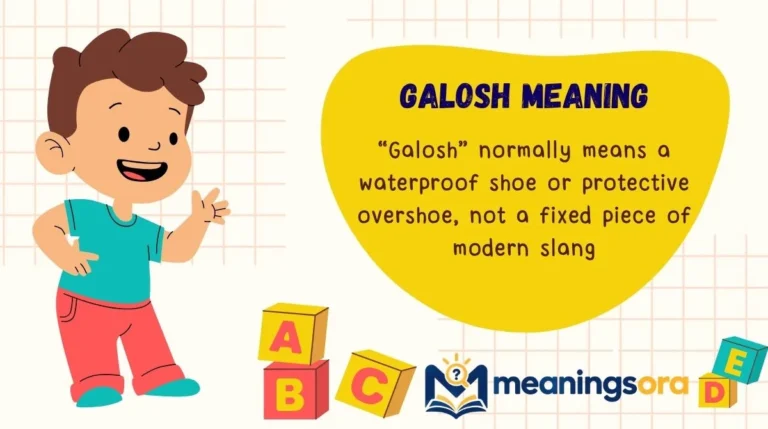
“Galosh” normally means a waterproof shoe or protective overshoe, not a fixed piece of modern slang. In online chat, it may also appear as a joke, nickname, meme word, or playful reference. Its meaning can change based on the conversation, the person using it, and the platform.
Common interpretations include:
- A waterproof shoe or overshoe
- A funny or random word used in a joke
- A nickname or username
- A playful reference to wet weather, mud, or shoes
If someone simply sends “galosh” with no context, there may be no hidden slang meaning at all.
The Most Common Meanings of “galosh”
1. A Waterproof Shoe
The main dictionary meaning of galosh is a waterproof shoe or overshoe. It is worn to keep feet dry when the ground is wet.
For example:
“I need my galoshes. It is raining outside.”
Here, “galoshes” refers to waterproof footwear.
This is the safest meaning to assume when the conversation is about rain, snow, puddles, mud, boots, clothing, or outdoor activities.
2. A Funny or Random Word
Online conversations often contain random words for humor. Someone may say “galosh” simply because the word sounds funny or unusual.
Example:
“Bro really said galosh.”
The word may have no deeper meaning. The humor can come from using an old-fashioned or unexpected word in a modern chat.
This type of use is common in playful group chats where people intentionally say strange things to make others laugh.
3. A Nickname
“Galosh” can also be used as a nickname. A person may have received the name from friends, a joke, a gaming group, or an old username.
Example:
“Galosh is joining the call tonight.”
In this case, “Galosh” may refer to a person rather than footwear or slang.
There is no universal rule for this use. The person or group may have its own reason for using the name.
4. A Username or Online Name
You may see “Galosh” in gaming, forums, social media profiles, or chat rooms as part of a username.
For example:
“Galosh_99 just joined the server.”
Here, it is simply an online identity.
A username does not automatically give the word a slang meaning. Many online names are chosen because they sound funny, memorable, or unique.
5. A Joke About Rain or Mud
Because galoshes protect feet from wet ground, someone might use the word as a playful way to talk about rain or mud.
Example:
“Time to put on the galoshes.”
The speaker may be joking about going outside during heavy rain.
The tone can be silly, old-fashioned, or dramatic rather than serious.
How “Galosh” Is Used in Real Conversations
Friends & Casual Texting
Among friends, “galosh” is most likely to be a joke, random word, nickname, or literal reference to footwear.
For example:
Friend 1: “It is pouring outside.”
Friend 2: “Grab the galoshes.”
This sounds playful because “galoshes” is not the word many people use in everyday casual speech.
Another example:
“Why did you just say galosh?”
“Idk, it sounded funny.”
In this situation, searching for a secret slang definition would not help. The word is being used for humor.
If your friend sends only “galosh,” you can ask:
“What do you mean by galosh?”
That is often better than guessing.
Instagram & Snapchat
On Instagram and Snapchat, unusual words can appear in captions, comments, usernames, or private messages.
A person might write:
“Rainy day = galosh mode.”
This likely refers to wet weather and shoes.
A comment such as:
“GALOSH!”
could be an inside joke between friends. Without seeing the post or knowing the people involved, it is hard to assign one exact meaning.
Social media also encourages short, strange, and unexpected comments. People sometimes use words because they look funny or get attention.
So, if you see “galosh” under a post, check the surrounding comments and the content of the post before deciding what it means.
Dating Apps
“Galosh” is not a common dating slang term with one fixed romantic meaning.
If someone uses it on a dating app, the meaning probably comes from the specific conversation.
For example:
“First date idea: coffee and a walk in the rain. Bring your galoshes.”
That is a playful reference to rainy weather.
But if someone sends:
“Galosh?”
with no context, it is reasonable to ask what they mean.
Do not assume that the word is automatically flirty, suggestive, or romantic. It is not a standard dating code word.
Gaming & Online Communities
Gaming communities often create their own slang and inside jokes. A word like “galosh” can become meaningful within one server or group even if it has no common slang meaning elsewhere.
For example:
“Galosh is camping again.”
Here, “Galosh” might be a player’s username.
Or:
“Equip the galosh!”
This could be a game-specific joke, item name, or invented phrase.
If you are in a gaming community and see the word used repeatedly, look at how other players use it. Local community slang can develop very quickly.
Work or Professional Chat
In professional communication, “galosh” is most likely to have its normal meaning.
For example:
“Please bring waterproof footwear because the site is muddy.”
Someone might casually call those shoes “galoshes.”
However, if a coworker suddenly writes “galosh” in a business chat without context, it may be an inside joke, typo, nickname, or accidental message.
Do not treat it as professional slang.
If the meaning matters, ask for clarification instead of guessing.
Is “Galosh” Rude, Flirty, or Offensive?
Usually, “galosh” is not rude, flirty, or offensive.
The standard word refers to protective footwear. Its unusual sound may make it useful in jokes or playful conversations, but the word itself is not generally an insult or sexual term.
Tone depends on context.
When It Feels Positive
“Galosh” can feel playful when friends use it as a joke.
Example:
“Bring your galoshes, adventure awaits.”
The tone is light and friendly.
When It Feels Negative
The word itself is not normally negative. However, a person could use almost any word sarcastically.
For example:
“Nice galosh, genius.”
Here, the insult comes from the overall sentence and tone, not from a standard negative meaning of “galosh.”
When It Feels Flirty
“Galosh” is not normally a flirty word.
Someone could create a private joke around it with a romantic partner, but that would be personal slang rather than a widely recognized meaning.
If someone uses it during flirting, look at the rest of the conversation before deciding what they mean.
Context Psychology
People often assume unusual words have secret meanings because online slang changes so quickly. But not every strange word is slang.
A useful rule is:
Context first, slang dictionary second.
Look at the message before and after the word. Check whether the person is talking about rain, shoes, a game, a person, or an inside joke.
How to Respond When Someone Says “Galosh”
Your response should match the situation.
Casual Replies
If a friend uses the word casually, you can keep things simple:
“Wait, what does that mean?”
“Galosh? Lol, explain.”
“Are we talking about shoes now?”
These replies show that you noticed the unusual word without making a big deal about it.
Funny Replies
If the conversation is clearly joking, you can play along:
“Say less. The galoshes are ready.”
“That is a very serious word.”
“Bro brought out the galosh.”
“Galosh era unlocked.”
The goal is to match the playful tone.
Neutral Replies
If you are unsure what the person means, ask directly:
“What do you mean by galosh?”
“Is that a nickname?”
“Do you mean the shoe?”
This is the best choice when the meaning is unclear.
Professional Replies
In work chat, avoid guessing.
You could say:
“Could you clarify what you mean by ‘galosh’?”
Or, if the topic is footwear:
“Do you mean waterproof footwear?”
A clear question prevents confusion.
Common Misunderstandings About “Galosh”
Mistake 1: Assuming It Is Gen Z Slang
Not every unusual word used online is Gen Z slang.
“Galosh” has a normal English meaning. Its appearance in a meme or text does not automatically create a new slang definition.
Mistake 2: Assuming It Is a Secret Insult
There is no standard modern slang rule that makes “galosh” an insult.
If someone uses it negatively, the surrounding words and tone matter.
Mistake 3: Assuming It Is Flirty
“Galosh” is not a widely recognized romantic or sexual slang term.
If someone uses it while flirting, the meaning may come from their private joke or the specific conversation.
Mistake 4: Confusing It With Similar Words
“Galosh” can be confused with words such as “galoosh,” “galoshes,” boots, or other terms for wet-weather footwear.
The plural form galoshes is also common.
Mistake 5: Ignoring Usernames
If you see “Galosh” in a game or social media chat, it may simply be someone’s username.
Always check whether the word is being used as a name.
Mistake 6: Treating Every Group’s Slang as Universal
Online groups can create their own vocabulary. A word can have a special meaning in one Discord server, gaming group, or friend circle without having that meaning elsewhere.
Similar Slang Terms You Should Know
Here are some common internet terms that can appear in the same type of casual online conversations:
- Bruh — A casual reaction showing surprise, disbelief, or annoyance.
- Bro — A casual way to address a friend or another person.
- Bestie — A friendly term for a close friend.
- LOL — Short for “laughing out loud.”
- LMAO — A stronger casual way to say something is very funny.
- W — Means a win, success, or something good.
- L — Means a loss, failure, or something embarrassing.
- Based — Often means someone said or did something confidently or in agreement with a group.
- Sus — Means suspicious or questionable.
- Cringe — Describes something awkward or embarrassing.
- Random — Used when something feels unexpected or unrelated.
- Inside joke — A joke whose meaning is mainly understood by a specific group.
These terms have clearer online meanings than “galosh.” That is another reason not to assume that every unusual word is established slang.
When You Should Avoid Using “Galosh”
Professional Settings
Avoid using “galosh” as invented slang in formal emails, business meetings, job applications, or important workplace messages.
The normal word is fine when you are actually discussing waterproof footwear.
If you mean something else, use clearer language.
Cross-Cultural Chats
People from different countries may not recognize the same slang or jokes.
Someone who does not know the word may think you are talking about a shoe.
When chatting with people from different language backgrounds, clear wording works better than unexplained inside jokes.
Sensitive Situations
Do not use random slang when discussing serious topics, complaints, emergencies, or emotional issues.
A strange joke can easily sound disrespectful when the conversation is serious.
When You Need to Be Clear
If the other person might misunderstand you, choose a direct word.
Instead of:
“Grab the galosh.”
you could say:
“Bring waterproof shoes.”
That leaves less room for confusion.
FAQs
What does galosh mean in slang?
“Galosh” does not have one widely accepted modern slang meaning. It normally means a waterproof shoe or overshoe. Online, it may also be a joke, nickname, username, or group-specific term.
Is galosh a Gen Z slang word?
Not generally. “Galosh” is not a standard Gen Z slang term with one fixed meaning. Some online groups may use it as an inside joke or invented slang.
What does galosh mean in texting?
In texting, the meaning depends on context. It may refer to waterproof footwear, a person’s nickname, a username, or a random joke. If there is no context, asking the sender is the safest choice.
Is galosh a bad word?
No. “Galosh” is not normally considered a swear word, insult, or offensive term. Its tone depends on how someone uses it.
Does galosh mean something flirty?
Not as a common slang meaning. If someone uses “galosh” while flirting, it may be part of a personal joke or conversation-specific meaning rather than established slang.
What is the plural of galosh?
The common plural is galoshes. It refers to more than one waterproof shoe or overshoe.
Why would someone randomly say galosh?
They may be joking, referring to a nickname or username, making an inside joke, or simply using the word because it sounds funny. The surrounding conversation usually reveals the intended meaning.
Final Thoughts.
The key point is simple: “galosh” is not normally a standard slang word.
Its main meaning is a waterproof shoe or overshoe, but online users can turn almost any word into a joke, nickname, meme, or inside reference.
If someone sends “galosh” in a text, do not immediately assume it has a hidden Gen Z meaning.
Look at the conversation, platform, and relationship between the people involved.
When the context is clear, you can respond naturally. When it is not, asking “What do you mean?” is perfectly fine.
Smart texting is not about knowing every unusual word. It is about understanding context, tone, and intent before you reply.

James Anderson is a content writer passionate about making words, phrases, and everyday concepts easier to understand.